

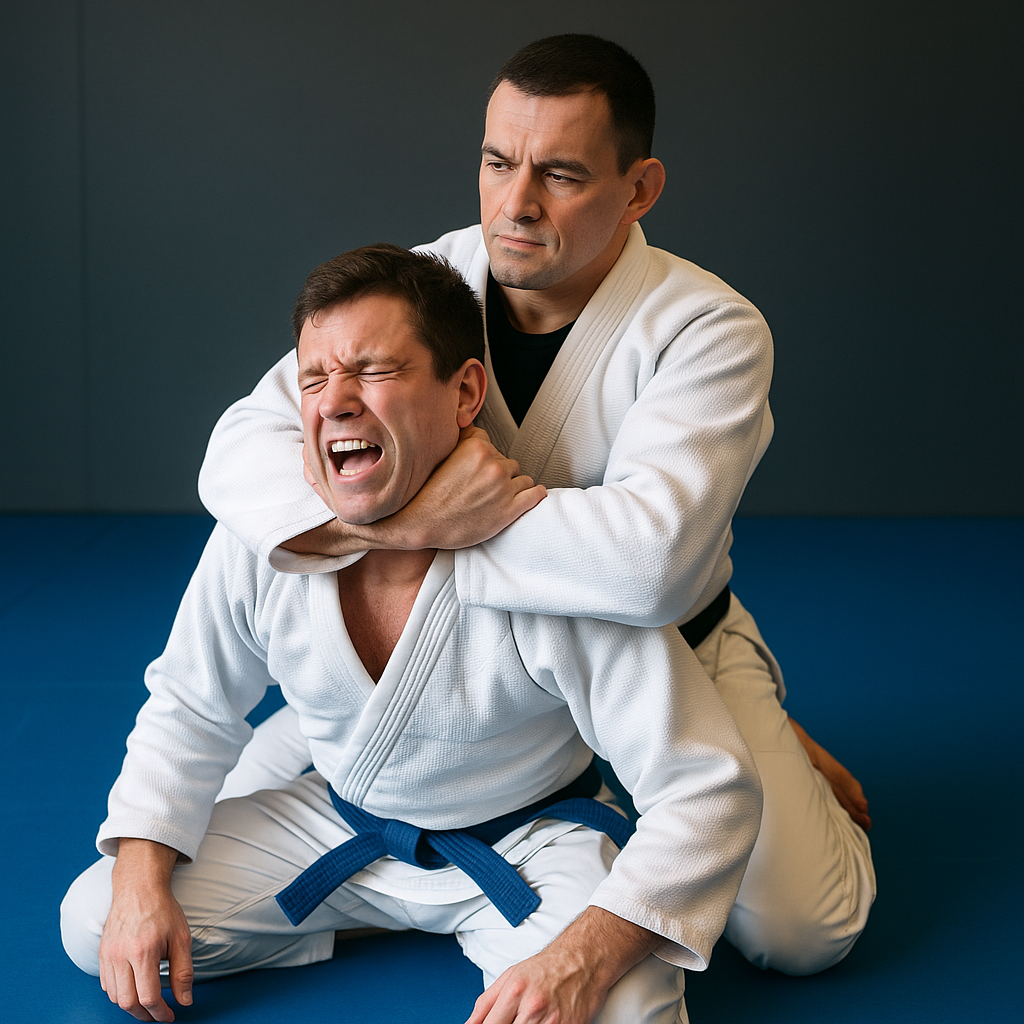
Ah, the guillotine choke. It is a technique that, like the katana in the hands of a samurai, can end conflict swiftly and decisively when executed with precision and intent. You’ve seen it—perhaps in countless MMA bouts, where chaos meets control. But what you may not yet understand is the why. Why is this technique so frequently used? Why does it succeed even against skilled opponents?
Sit. Breathe. Let me explain.
The guillotine is not simply a submission. It is a reaction. A counter. A lesson in awareness and opportunity. It punishes carelessness. The moment your opponent places their head outside your centerline—too low, too exposed—they offer you their neck like a sheep to the butcher. A true martial artist does not miss this gift.
Let us now walk the path of knowledge together.
⚔️ The Two Paths of the Guillotine
In Brazilian Jiu-Jitsu, we distinguish between two primary types of guillotine choke: the air choke and the blood choke.
The air choke targets the windpipe. Your forearm acts like a blade, pressing into the throat, disrupting breath and forcing panic. This type can be brutal and immediate, but it may lack subtlety and finesse. It is the weapon of the desperate or the opportunistic.
The blood choke, however, is the art of patience. It compresses the carotid arteries on either side of the neck, cutting off blood flow to the brain. If your technique is true, your opponent will feel the world grow dark in mere seconds. It is quiet. Efficient. Gentle, even—until unconsciousness sets in.
Both are effective. Both have their place. But know which one you are using. A skilled practitioner is never unsure of their own technique.
🌱 Position Before Submission
Now, young one, before we speak of motion and grip, remember this: position is the parent of success. Without proper position, your guillotine is like a sword with no edge.
This technique may be performed from standing or from the ground. Each variation has its advantage.
While standing, you use gravity and leverage to enhance your control. You may catch the guillotine during a failed takedown attempt—when the opponent shoots in and leaves their neck vulnerable. This is when you must be swift and decisive.
On the ground, we often employ the guillotine from the guard position. If your opponent attempts to pass with poor posture, you snatch the neck and lock them within your legs. Now they are trapped—in your grip and in their mistake.
🧠 The Basic Guillotine: Standing Technique
Let us begin with the standing variation, the one I teach to all beginners before the mat becomes their home.
- Break their posture: With a firm grip on their gi or collar, pull their head down. Use their momentum against them, as you guide their head below your chest level. This makes the neck accessible.
- Wrap the neck: Slide your choking arm around their neck, tucking the blade of your forearm under their chin. Think of a snake wrapping its prey—not with violence, but with inevitability.
- Secure your grip: Use your free hand to clasp the wrist of your choking arm. Your elbow should be snug against their chest, keeping their head locked tight.
- Set your stance: Step one leg forward, grounding yourself. Stand tall and twist your hips slightly toward your lead leg. This subtle movement generates torque—pressure—that finishes the choke.
If you have followed each step correctly, your opponent will tap or fade. If not, go back. Reflect. Adjust. The mat reveals all truths.
🧬 The Spine-Locking Guillotine
Now, for the more advanced student, allow me to show you the spine-locking guillotine—a variation that not only chokes but bends the body into submission.
You begin as before: pull their head, wrap the neck, and secure the initial grip. But now, you go deeper.
- Turn their head with your choking forearm toward your own hand. This adds torsion—not just on the neck, but the entire spine.
- Place your free hand against their back, applying pressure toward the direction of the turn.
- Now clasp your own wrist again, and gently lean backward, amplifying the torque along their spinal column.
This is not just a choke—it is a lesson in alignment. Done correctly, it is devastating. Done poorly, it is ineffective. Respect this technique. Use it wisely.
🌊 Application in Life and Combat
The guillotine is more than a move for competition. It is a tool for self-defense. In the chaos of a street encounter, it is often the first submission a BJJ practitioner learns to apply under duress. Its simplicity is its power. Its adaptability, its strength.
But understand this: technique alone does not win the day. Timing, positioning, and awareness must become instinct. That can only come from training. From repetition. From discipline. The mat teaches you if you are willing to listen.
🧘 The Role of the Sensei and the Student
When you train under your sensei, you are not merely learning to choke. You are learning control—of your body, your breath, your mind, and your enemy. We do not seek to hurt. We seek to neutralize.
The guillotine teaches us that even a small opening—one slight mistake—can lead to defeat. And so, we train to remain present. Alert. Humble.
Some students ask, “Sensei, how can I master this technique?”
And I say: Master yourself, and the choke will follow.
🥇 Final Words From the Mat
There are many techniques in Brazilian Jiu-Jitsu. The guillotine is but one. Yet in its elegance and efficiency, it carries deep lessons. You must not only know how to apply it—you must know when, why, and with what intent.
Listen to your body. Feel your opponent’s weight, posture, and energy. Do not force. Flow. When the neck appears, do not hesitate. Be like water—and tighten your grip until the tap comes or the lights fade.
Now, get up. Bow to your partner. Bow to the mat. The lesson is over—but the journey continues.
Train hard, stay humble… and always be ready to crave the Boom.
— Sensei